
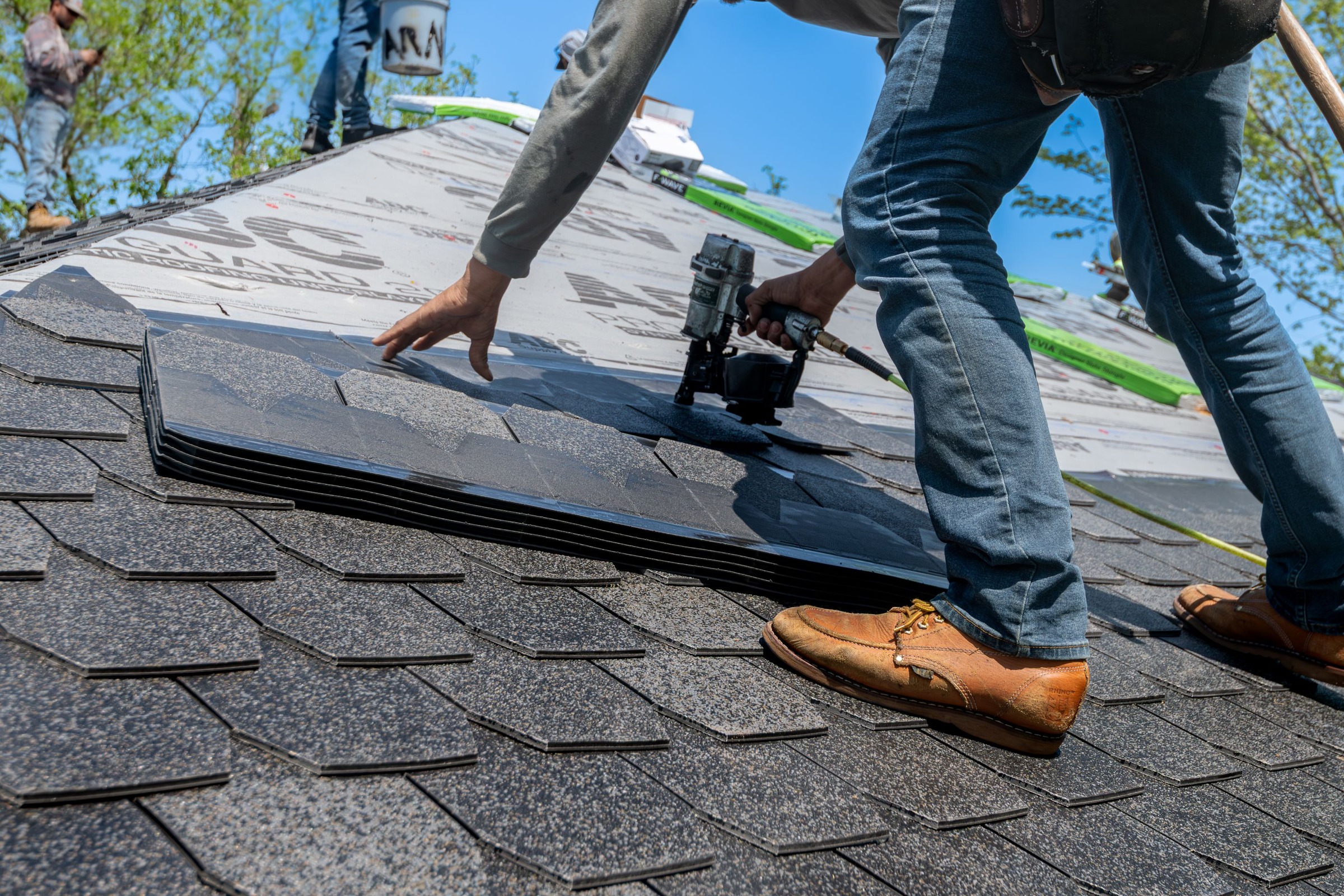
A few missing shingles don’t necessarily mean you need a new roof. For shingle roof repair in Vaughan, we start by finding where water enters and whether the roof around it is sound. Sometimes a tab blows onto the lawn. Sometimes the only clue is a brown ceiling mark in Maple. Matching and sealing replacement shingles may be enough, but only after checking beneath the gap rather than simply covering it.
We repair asphalt shingle roofs on homes throughout Vaughan, Woodbridge, Maple, Concord and Kleinburg, and what follows is the damage we see most often, the way we repair it, and how we decide when a repair is no longer the right answer.
Missing shingles or a new leak? Request a free estimate for shingle roof repair. Call (416) 860-5976 or request a free estimate online.
Wind only needs to lift a tab to start causing trouble. Once the seal strip underneath lets go, the next gust has somewhere to catch and may tear the shingle away. Even one missing piece leaves the underlayment exposed to weather it wasn’t meant to face for long. A small patch of damage can therefore matter even when most of the slope looks undisturbed.
An ageing shingle doesn’t always lie flat any more. It may curl along its edge or form a hollow in the centre. Either change gives wind a way underneath and allows water to work back under the covering. We look at how widespread that change has become rather than treating every curled tab as an isolated defect.
A roof can look complete from the driveway and still have cracked shingles. Repeated freezing and thawing can split them, while hail or someone walking on the roof can cause damage too. That sort of crack may be too small to identify from street level.
The grit on a shingle is there to protect the asphalt from sunlight. Finding it gathered at a downspout can be a sign that the surface is wearing away. Where the asphalt is left bare, ageing speeds up, even if you haven’t noticed a leak inside. It’s something to mention when you call about the roof.
A nail that works upward can push into the shingle sitting above it. The lifted spot may be small, but it opens a possible route for water. Replacing a nearby shingle alone won’t necessarily deal with that cause.
Before blaming the field of shingles, we check the places where the covering meets something else. A vent boot can split, flashing can pull away beside a chimney, and a valley can wear thin. Those are all parts we inspect, even when the call began with a missing shingle. Our post on roof flashing explains why the leak isn’t always where the homeowner first suspects.
The stain inside is a starting clue, not a marker directly beneath the opening. Water may travel along the deck or a rafter before it drops onto the ceiling. We trace it back from the roof, using the attic as well when needed, so we repair the entry point rather than guess from the room below. That investigation comes before lifting out damaged shingles.
Underneath, the deck needs to be solid. We remove and replace softened wood before covering it again. Around the damaged area we lift the neighbouring shingles carefully, take out the broken pieces and nails, then fit replacements with the right overlap. They need nails in the proper positions and a seal that resists lifting. Checking the adjacent area afterward helps avoid solving one opening while leaving the next one beside it.
The Asphalt Roofing Manufacturers Association offers homeowner information on the way asphalt roofs are built and maintained. The shingles are only part of that assembly, alongside underlayment and flashing, with ventilation affecting the roof too. We follow the manufacturer’s installation instructions for the particular shingle, including how many nails it needs and where they belong. A neat looking patch isn’t enough if it ignores the way those layers work together.
With a newer roof, matching brand and colour is often fairly straightforward. After roughly ten years the existing shingles have faded, which means a new piece may look brighter even when it’s the correct product. That difference often becomes less noticeable over a season or two. Where you’ll see the repair from the street, we talk through the appearance before work starts instead of letting it surprise you afterward.
If the deck is solid and damage is limited to one part of a roof that’s under about 15 years old, a repair will often be the sensible choice. The rest still needs checking.
Broad areas of curling or cracking tell a different story, especially with bald shingles or leaks in more than one place. Repeated spring repairs may mean you’re no longer dealing with a single patch of damage. We’ll tell you when the roof appears near the end of its useful life rather than keep recommending the same small fix. Our shingle roofing in Vaughan page explains the installation approach when replacement is the better route.
Stay off the roof while you’re waiting for us, especially in rain or ice. Inside, move valuables away from a leak and catch the drips in a bucket. Photographs help document what’s happening for your own records and any insurer. If shingles have come down onto the lawn, keep them so we can identify the product and colour rather than throwing away that useful clue.
No leak today doesn’t mean the missing shingle can wait until spring. The exposed underlayment can deteriorate in sunlight, and heavy rain or ice may push water past it later. Repairing the opening early can avoid a much larger job involving rotten deck wood. After strong wind, a roof inspection in Vaughan can also find lifted pieces that haven’t yet landed in the garden, while there’s still an opportunity to deal with them.
Watch for changes without climbing a ladder. From the sidewalk, look for gaps, curled edges or an area with a different shade. Grit in the eavestrough after a storm is another clue. Upstairs, note new ceiling stains or damp attic wood after rain. In winter, large icicles concentrated on one section can point to heat loss and ice damming. Any of these is worth raising before more bad weather.
We’re the team at Trusted Roofers Toronto. For about 20 years our work has involved roof repair and replacement across Vaughan, Toronto and the GTA, on flat roofs as well as asphalt shingle, metal, cedar, slate and tile. You can read more about our company and that background on our site.
Yes, if the damage really is local and the deck remains sound. We don’t need to replace undamaged shingles simply because a few nearby have failed.
A small job may take a few hours. Replacing deck wood or dealing with a larger area changes the time needed.
We can make small emergency repairs in winter. Since sealing works better in warmer conditions, hand sealing or another visit may be needed.
Check your policy and the cause of the damage. Storm or wind damage is often covered, unlike ordinary wear. Photos and a written description help explain what happened to the insurer.
It needs to address why water got in, not just cover the spot. Sound decking and properly fitted, sealed shingles are part of making the repair last.
We repair shingle roofs across Vaughan, including Woodbridge, Maple, Concord, Kleinburg and Thornhill, as well as nearby Richmond Hill and North York. Our office at 716 Garyray Drive in North York sits close to Vaughan, so we can usually reach you quickly. Call us or request a free estimate, or visit our Vaughan roof repair page.
Trusted Roofers Toronto
716 Garyray Drive, North York ON M9L 1R3
Phone: (416) 860-5976
Hours