
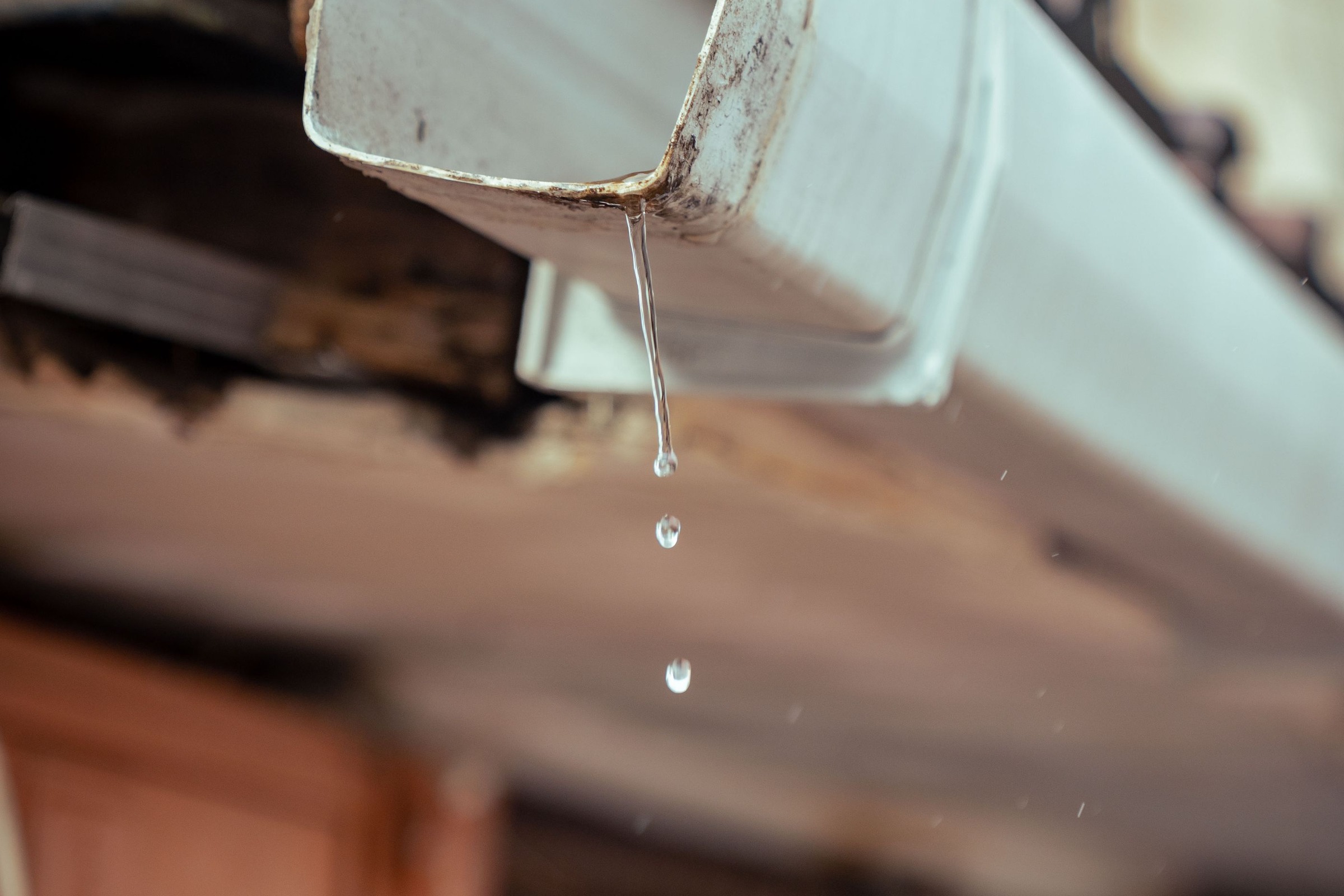
Are eavestroughs necessary? For nearly every house in Mississauga, yes. A roof sheds a startling amount of water in a summer thunderstorm. With no eavestroughs, all of it drops in a line along the edge of the house, right beside the foundation. A few years of that and the water has splashed up onto the siding and brick, dug a little trench in the soil, kept the ground around the basement soaked, and worked its way into whatever cracks it could find. Eavestroughs catch it and send it down the downspouts to somewhere it can drain off.
We install and repair eavestroughs all over Mississauga. Here’s what they do, what goes wrong when they’re missing or failing, and the handful of houses that can get by without them.
Thinking about new eavestroughs or replacing old ones? Request a free estimate. Call (416) 860-5976 or request a free estimate online.
The foundation, mostly. Moving roof water away from the base of the house keeps the soil around the basement from staying wet. They also stop water sheeting down siding, brick, windows and doors, and they spare the flower bed that strip of washed-out soil and mulch you get under a bare roof edge.
On their own they don’t do much. The downspouts have to carry the water well clear of the walls, and the ground should slope away from the house. Troughs, downspouts and grading work as one system.
The damage is slow. That’s why people ignore it.
Water pooling against the foundation is one of the most common reasons basements leak. In its guidance on basement flooding, the City of Toronto lists directing roof water away from the house as one of the steps homeowners can take to cut the risk (City of Toronto basement flooding). Mississauga houses are no different. Soil that stays saturated can also swell and shrink, which puts extra pressure on foundation walls.
Splash-back stains siding and wears away mortar joints. Water running down a wall can slip behind window and door trim and rot the wood from there.
No trough, and water wicks into the fascia board. Rot follows. Then squirrels and raccoons, once there’s a soft spot to chew.
People forget this one. Water dripping off the roof edge in a Mississauga winter freezes on the walkway, the front steps and the driveway. Somebody’s going to slip. Usually it’s the person carrying groceries in from the car at six o’clock, in the dark, on a step that looked wet but was actually glazed.
One heavy storm can carve a trench along the drip line, wash the mulch onto the lawn and drown whatever was planted there.
A few. Very wide overhangs can throw water far enough from the walls. A house on a slope sometimes has ground that carries water off on its own. Some homes have gravel drip edges with drainage built in to handle the runoff.
Not many Mississauga houses fit that, though. Most here have modest overhangs, full basements and fairly flat lots, so eavestroughs remain the simplest protection. Not sure about yours? We can come out and tell you honestly whether every side needs troughs.
When a trough clogs or sags and fills up, it spills over the front, the water still lands at the foundation, and now it soaks the fascia on the way down.
Most of this is visible from the yard. Water pouring over the edge during a rainstorm is the clearest sign. Drips at seams and corners, troughs leaning away from the house, downspouts emptying right against the wall. Soft soil or standing water beside the house after a storm says the same thing. Our eavestrough repair in Mississauga page explains how we fix each of these.
A lot of systems fall short right here. The downspout should empty onto a splash pad or an extension that carries the water away from the wall, onto ground that slopes away from the house. Not onto a walkway. Not onto a neighbour’s lot. If your downspouts once fed underground pipes, it’s worth checking that the connection still drains, because a blocked pipe backs water right up into the trough.
Size comes first, whether it’s a first install or a replacement. A large roof or a steep pitch pushes more water, and the trough has to keep up. Then the number of downspouts and where they go, since extra downspouts cut overflow on long runs. Most homes here end up with aluminum. We like sturdy hangers spaced close together, because a Mississauga trough carries snow and ice for months. And the fascia has to be sound first. Rotten board, and new troughs simply won’t hold.
Our eavestrough installation in Mississauga page explains how we put in new systems, and our soffit and fascia work covers the boards behind them.
Once they’re up, the routine is short. A cleaning in late spring, after the seeds and blossoms come down, and another in late fall once most leaves have dropped. During a heavy rain it’s worth watching them for a minute: water should run to the downspouts, not over the front edge. Big icicles in winter can mean ice is building in the trough or at the roof edge. After a bad storm, a lap around the house turns up sagging sections or downspouts that came loose, and caught early, a small repair stays small.
The team at Trusted Roofers Toronto wrote this. We’ve been installing and repairing roofs and eavestroughs across Toronto and the GTA, including Mississauga, for about 20 years. More about our company.
The Ontario Building Code deals with drainage in general terms, and local rules vary. For most homes, eavestroughs are the practical way to keep water away from the foundation, whether or not a rule requires them.
Removing them usually trades one problem for another. Ice dams are mostly caused by heat loss and poor attic ventilation, which should be fixed at the source.
Usually, but not always. Gable ends without a roof edge do not need them, and some areas with wide overhangs may not.
Far enough that water drains away from the foundation rather than pooling beside it. Extensions or splash pads help.
They can reduce clogs under trees, but they still need periodic checks.
We install, clean and repair eavestroughs throughout Mississauga, including Port Credit, Clarkson, Meadowvale, Streetsville and Erin Mills, as well as Brampton and Toronto. Our office is at 716 Garyray Drive in North York. Call us or request a free estimate and we will look at your home.
Trusted Roofers Toronto
716 Garyray Drive, North York ON M9L 1R3
Phone: (416) 860-5976
Hours